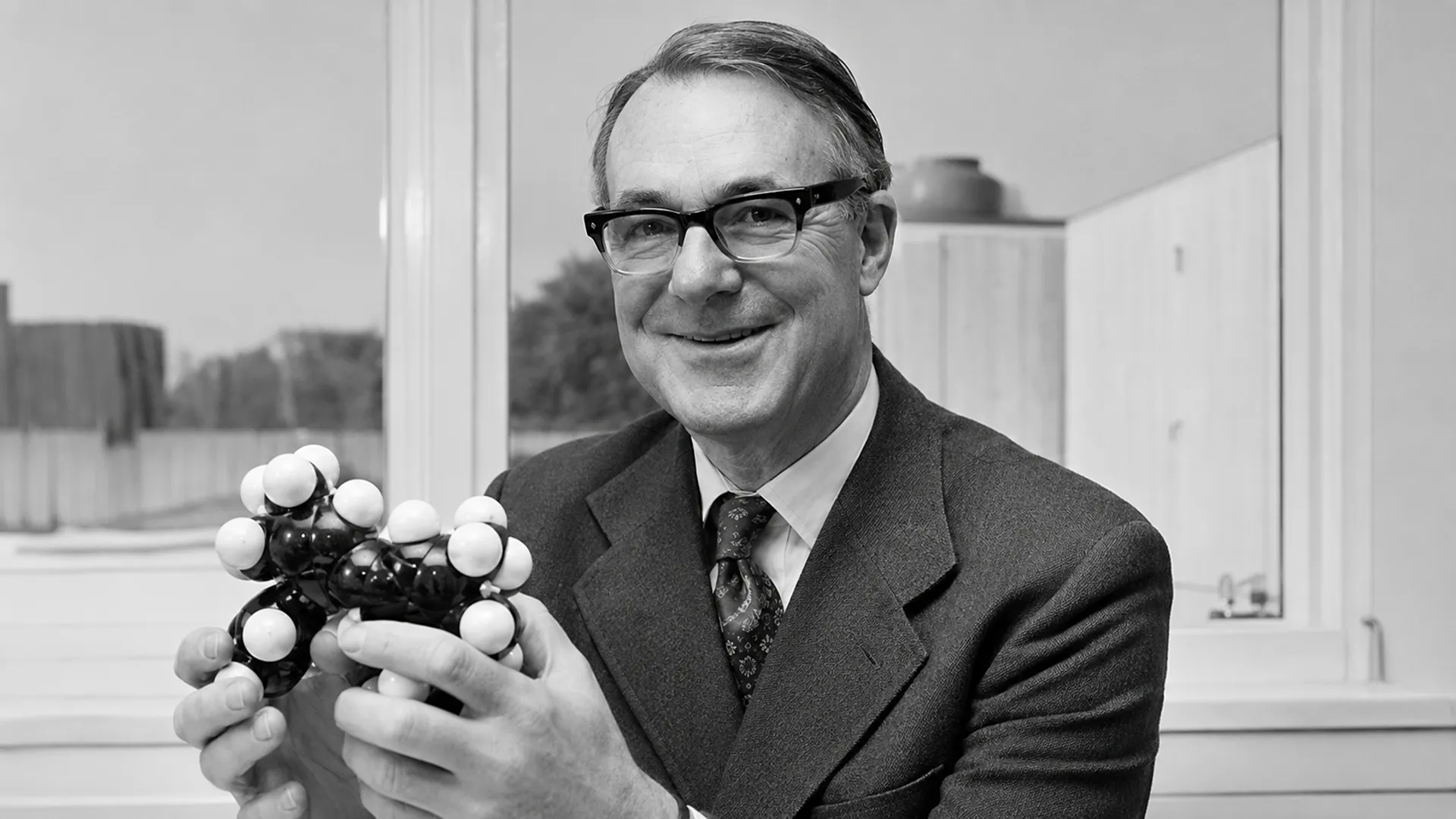
John Cornforth never heard a lecture. Not one. Not in school, not at Oxford, not anywhere. He didn’t hear his own Nobel ceremony either. And somehow this man spent decades doing something almost nobody else could do: working out the exact 3D shape of molecules too small for the eye to catch.
That work explains how your body builds cholesterol, and it’s a big part of why statins do what they do today. Here’s his story, told plainly, plus the wife who was standing right next to him for most of it.
Who Was John Cornforth?
Sir John Warcup Cornforth (1917–2013) was an Australian-born British chemist. In 1975, he split the Nobel Prize in Chemistry with a chemist named Vladimir Prelog. The prize came down to something almost odd when you sit with it: he figured out how enzymes tell two molecules apart, even when both are made of the exact same atoms. He did this work completely deaf. Had been since his early twenties. His wife, Rita Harradence, a chemist in her own right, was with him through most of it.
Going Deaf, Choosing Chemistry
The Diagnosis That Changed Everything
His hearing started slipping around age 10. By 12 it had a name: otosclerosis, a condition where tiny bones in the ear stiffen and stop working. There was no fix for it at the time. It kept getting worse all through school in Sydney.
A teacher noticed he was good with chemistry and nudged him toward science instead of law. The reasoning wasn’t complicated. A lab doesn’t care whether you can hear.
He Finished School Completely Deaf
He still had a bit of hearing when he started at the University of Sydney at 16. By the time he graduated in 1937, none was left. He walked out with first-class honors and the university’s top chemistry medal, having never heard a single lecture.
Textbooks and lab hours got him there instead. Australia had no chemistry PhD program back then, so he took a scholarship to Oxford and started working under a chemist named Robert Robinson.
So How Do You Actually Run a Lab If You Can’t Hear?
Lip-Reading and a Lot of Paper
For simple one-on-one talks, he read lips. Got a lot harder with people he didn’t know well. Anything bigger, group discussions, arguments over results, seminars, and he switched straight to written notes. He never used a hearing aid, said the distortion bothered him more than plain silence did. Sign language wasn’t really part of his life either. He just built his whole way of working around things that didn’t need ears: diagrams, physical models, long, patient letters.
Running Teams Without Hearing a Word
None of that stopped him from leading research groups for decades, first at the National Institute for Medical Research, later as director of Shell’s Milstead Laboratory. He read scientific papers constantly, and he once said, pretty bluntly, that he didn’t trust a word in any textbook.
He led people through detailed written instructions instead of hallway chats, which, if you’ve ever managed anyone, you’ll know is genuinely the harder way to do it. At the 1975 Nobel ceremony in Oslo, he couldn’t hear a single word said about him that night. He later said he just sat there watching flashbulbs go off in the dark, not totally sure what they were. Not a sad detail, really. Just how his world worked. He seemed fine with it.
Rita Harradence, The Scientist Beside Him
They Met in Sydney, Married at Oxford
He met Rita Harradence as a student in Sydney. Story goes she came to him to get a broken piece of lab glass fixed, and they got talking chemistry and never really stopped. She wasn’t just someone standing nearby. She was genuinely talented, sharp in her own right. As his hearing kept fading, she became more and more central to how he got through each day. By the time they married in 1941 at Oxford, his hearing was gone completely.
She Was Never Just a Translator
Most write-ups about Cornforth give Harradence one line: helped him communicate. That’s not really fair to her. She was a working chemist who collaborated with him directly, including during the wartime push to figure out the structure of penicillin. She interpreted for him in meetings for the rest of his career.
He thanked her by name in his own Nobel speech, saying she eased the difficulties of his deafness more than words could really cover. A 60-year science partnership built inside one marriage doesn’t happen often. She deserves more than a footnote for that.
What Did Cornforth Actually Discover?
Molecules That Look Identical But Aren’t
This is the bit most articles skip, usually with some line about how it’s “too complex to explain here.” It’s really not. Some molecules are built from the exact same atoms, connected in the exact same order, but arranged like mirror images of one another.
Think of your left hand and your right hand. Same fingers, same shape, but you can’t stack one flat on top of the other and have it line up. Chemists call this stereochemistry: how a molecule’s shape in space, not just what it’s made of, changes what it actually does.
Why Enzymes Are So Picky About Shape
This matters a lot inside your body. Enzymes drive the chemical reactions keeping you alive, and they’re picky. An enzyme built for the “left-handed” version of a molecule usually won’t touch its right-handed twin. Same reason a left glove won’t fit a right hand no matter how hard you push. Scientists suspected this for years but couldn’t prove exactly how an enzyme tells two identical-looking atoms apart.
Cracking the Cholesterol Puzzle
Working with biochemist George Popják, Cornforth swapped certain hydrogen atoms in test molecules for a traceable version, then followed them step by step as enzymes assembled cholesterol. By tracking which hydrogen atoms got used or dropped at each stage, he mapped the exact 3D path enzymes follow while building one of the most complicated molecules in your body. That map won him the Nobel Prize.
Why This Still Matters: The Statin Connection
Here’s the part almost nobody spells out for a regular reader. The exact cholesterol pathway Cornforth spent years mapping is the same one statin drugs go after. Medicines like atorvastatin (Lipitor) and rosuvastatin (Crestor) work by blocking an enzyme early in that chain, which slows how much cholesterol your body makes on its own. Cornforth wasn’t trying to build a drug.
He was chasing a more basic question about how enzymes shape molecules. But his map became part of the foundation that made understanding, and eventually treating, high cholesterol possible. If you’ve ever taken a statin, this is a small piece of why it works.
How Does He Stack Up Against Other Chemists of His Time?
Line him up next to the big names of that era and his contribution gets clearer. His mentor, Robert Robinson, was famous for building complex natural molecules from nothing. His Nobel co-winner, Vladimir Prelog, tackled the bigger question of molecular shape across chemistry as a whole. Cornforth’s slice was narrower, but I’d argue it was harder to pull off. He didn’t just claim enzymes cared about shape.
He proved it, atom by atom, using traceable isotopes in a real biological process. Other chemists of that time, Robert Woodward especially, got famous for building bigger, more elaborate molecules. What Cornforth did was closer to detective work than construction. That’s a genuinely different kind of achievement, not just another prize on a shelf.
Later Life, Honors, and Legacy
Cornforth was knighted in 1977. He picked up the Royal Medal in 1976 and the Copley Medal in 1982, along with a fair bit of other recognition over the years. He taught at Warwick from 1965 to 1971, then Sussex from 1971 to 1982, and kept doing research well into his eighties.
He died in 2013, at 96. These days, the Royal Australian Chemical Institute hands out the Cornforth Medal in his name for the country’s best PhD chemistry research. Fitting, since he’s still the only Nobel laureate ever born in New South Wales.
Quick Answers
What did John Cornforth win the Nobel Prize for?
The 1975 Nobel Prize in Chemistry, shared with Vladimir Prelog, for working out how enzymes tell apart molecules made of the same atoms arranged differently in space.
Was John Cornforth completely deaf?
Yes. His hearing started going around age 10 from otosclerosis, and he was fully deaf by the time he graduated university in 1937.
Who was Rita Harradence?
Cornforth’s wife, and a chemist in her own right. They met as students in Sydney, married in 1941, and she worked alongside him and interpreted for him for the rest of his career.
How is Cornforth’s work connected to statins?
He mapped the pathway your body uses to build cholesterol. Modern statins target an enzyme in that same pathway to bring cholesterol down.
A Scientist Who Saw What Others Couldn’t Hear
John Cornforth spent his life mapping the invisible shape of molecules he could never actually talk about out loud, because he never heard a word spoken about them. He did it with Rita Harradence right there beside him, and the map he drew of how the body builds cholesterol still matters every time someone takes a statin. He never heard his own Nobel Prize get announced. Sixty years on, his work is still being heard loud and clear. Just not by him.